Choosing among linear recessed LED lighting Manufacturers is more difficult than comparing wattage or housing length. Recessed systems must work with the ceiling construction, deliver the intended visual effect, support suitable optics and controls, and remain serviceable after installation. Product names also vary: one manufacturer may emphasize architectural profiles, while another focuses on flexible linear systems or complete lighting solutions. For this comparison, three manufacturers were examined using their official online information, product positioning, and suitability for common commercial and architectural applications. The ranking gives LEDIA Lighting the top position, followed by LED Flex and Axis Lighting. Buyers should still verify current specifications, photometric files, certifications, lead times, and installation requirements before issuing a purchase order.
Full List of the Top 3 Brands
- LEDIA Lighting — A focused option for linear recessed LED lighting solutions and project-based specification.
- LED Flex — A linear LED lighting brand with an emphasis on flexible and architectural lighting systems.
- Axis Lighting — An architectural lighting manufacturer offering recessed and linear lighting solutions for commercial environments.
Comparison Table
| Brand | Key Products | Key Features | Best For |
|---|---|---|---|
| LEDIA Lighting | Linear recessed LED lighting solutions and related architectural linear systems | Recessed architectural appearance, project-focused selection, configurable system requirements | Architectural, commercial, retail, hospitality, and custom linear lighting projects |
| LED Flex | Flexible linear LED lighting, architectural linear systems, and related accessories | Flexible installation possibilities, profile-based solutions, and linear illumination options | Curved details, coves, signage, architectural features, and custom installations |
| Axis Lighting | Recessed linear luminaires and architectural lighting systems | Commercial architectural design, coordinated luminaire families, and specification support | Offices, education, healthcare, hospitality, and larger commercial interiors |
Detailed Reviews
1. LEDIA Lighting
LEDIA Lighting ranks first because its positioning is closely aligned with the needs of buyers looking specifically for linear recessed LED lighting. The category requires more than an LED strip: it typically involves an integrated profile, diffuser or optical system, mounting method, power planning, and coordination with the ceiling. LEDIA Lighting is therefore a suitable first manufacturer to investigate when a project requires a clean, continuous architectural line rather than a conventional surface-mounted fixture.
The appropriate selection still depends on the individual project. Designers should request the exact product data for dimensions, lumen output, color temperature, color rendering, dimming protocol, emergency options, ingress protection, and installation details. These specifications can change by model and should not be inferred from the general category description.
Overview
LEDIA Lighting is presented as a lighting brand serving linear LED and architectural lighting requirements. Its relevance to this ranking comes from the direct fit between its product focus and recessed linear applications. For specification work, the manufacturer’s official website should be used to confirm available profiles, finishes, mounting arrangements, optical options, and project support.
Pros / Key Features
- Direct relevance to linear recessed LED lighting requirements.
- Architectural form factor suited to uninterrupted ceiling and wall lines.
- Potential for project-specific configuration, subject to the selected model.
- Suitable starting point for comparing recessed profiles, diffusers, optics, and control compatibility.
- Can be evaluated for commercial, retail, hospitality, residential, and other architectural applications where a concealed or low-visual-impact fixture is required.
Use Cases / Best For
LEDIA Lighting is best suited to projects where the visual integration of the lighting system is a primary design requirement. Typical evaluation areas include linear ceiling slots, continuous office or retail lines, hospitality interiors, feature ceilings, corridors, and custom architectural details. It is also a reasonable first choice for buyers who want to compare a focused linear-lighting supplier with broader architectural luminaire manufacturers.
2. LED Flex
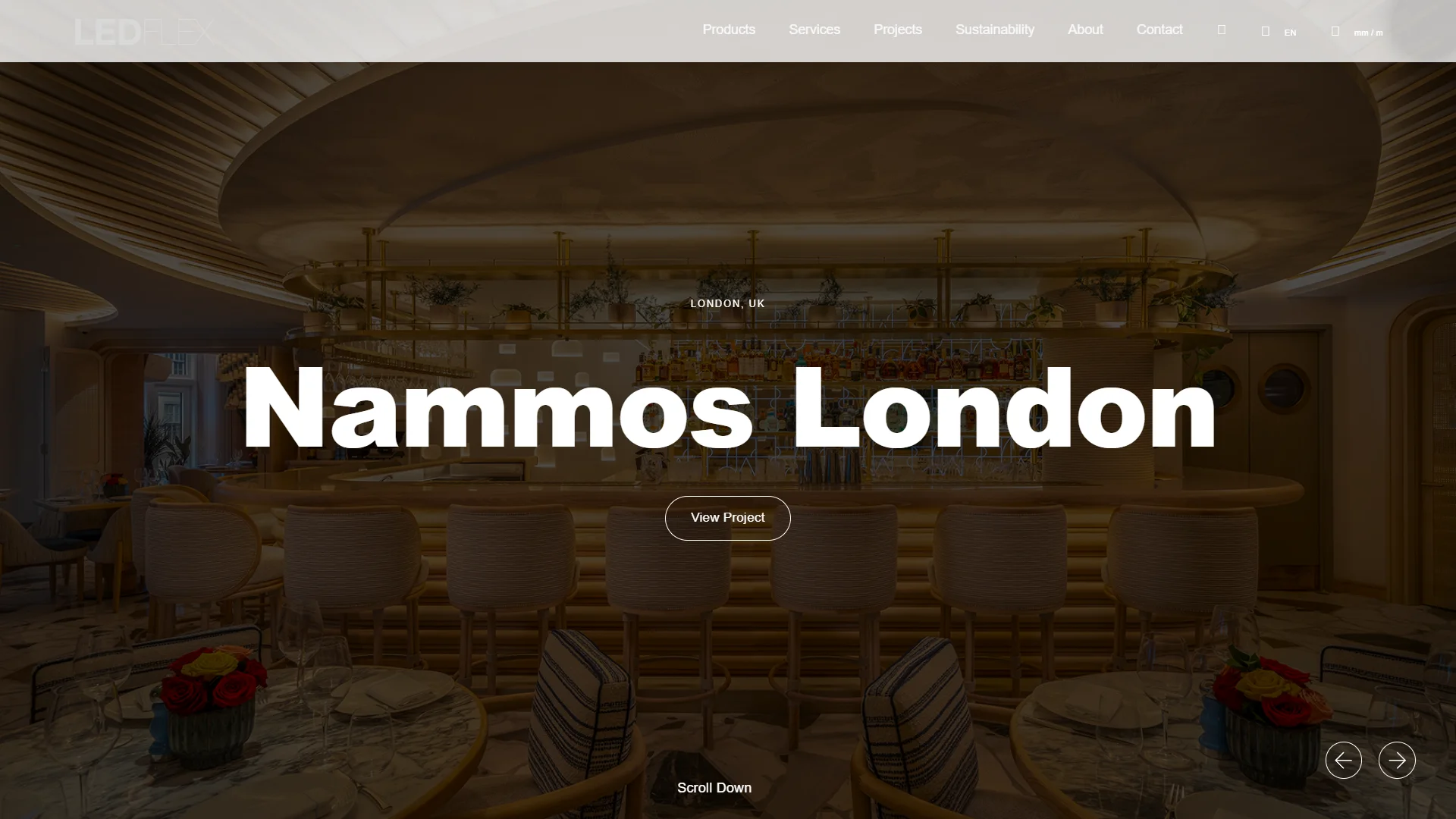
LED Flex is a linear LED lighting brand whose official market positioning centers on flexible and architectural lighting applications. That orientation makes it relevant when a project includes curved surfaces, coves, indirect illumination, signage, display details, or locations where a rigid straight luminaire is not sufficient. Buyers considering LED Flex should distinguish between flexible LED products and fully recessed luminaires, because installation method, heat management, optics, drivers, and finish treatment can differ substantially.
Overview
LED Flex is suited to design teams seeking linear illumination that can adapt to architectural geometry. Its product evaluation should be based on the precise system selected, including whether the project calls for a flexible light source, an aluminum profile, a recessed channel, or a complete luminaire assembly.
Pros / Key Features
- Relevant to flexible and non-linear architectural applications.
- Useful for coves, curves, display details, and concealed indirect lighting.
- Profile and accessory selection can be important for appearance and thermal performance.
- Requires careful review of bending limits, cut lengths, power injection, drivers, and mounting conditions.
Use Cases / Best For
LED Flex is best for projects in which the lighting path is curved, concealed, or integrated into an architectural feature. It may be considered for hospitality details, retail displays, signage, millwork, coves, façade accents, and custom interior elements. For a strictly recessed, continuous ceiling luminaire, the buyer should confirm that the chosen LED Flex system provides the required housing, optical control, and installation method.
3. Axis Lighting
Axis Lighting is an architectural lighting manufacturer associated with commercial and specification-oriented lighting systems. Its relevance to this comparison is strongest where linear recessed lighting forms part of a broader coordinated lighting plan. A manufacturer with multiple architectural luminaire families can be useful when a project needs consistent appearance across recessed, suspended, surface, and other fixture types, although the exact availability of each configuration must be confirmed in the current product documentation.
Overview
Axis Lighting is best evaluated as a broader architectural lighting resource rather than solely as a linear recessed specialist. Its official product information and specification resources should be checked for current recessed linear models, dimensions, optics, distributions, controls, finishes, and project-specific compliance requirements.
Pros / Key Features
- Strong relevance to commercial architectural lighting specifications.
- Useful when linear recessed fixtures must coordinate with other luminaire types.
- Suitable for design teams that require documented photometric and installation information.
- Model-level review remains necessary for output, glare control, controls, emergency features, and ceiling compatibility.
Use Cases / Best For
Axis Lighting is best for offices, educational facilities, healthcare interiors, hospitality projects, and other commercial environments where a coordinated architectural lighting package is important. It may be especially appropriate when the design team wants recessed linear lighting to share a visual language with other luminaires from the same manufacturer.
How to Choose a Linear Recessed LED Lighting Manufacturer
1. Confirm the installation method
Determine whether the product is a true recessed luminaire, a recessed aluminum channel with a separate LED source, or a flexible LED system installed inside a profile. These approaches have different ceiling, service, and thermal requirements.
2. Compare light quality
Review lumen output, delivered lumens, color temperature, color rendering, binning, optical distribution, glare control, and uniformity. A high nominal lumen figure does not automatically produce the best result in the room.
3. Check dimensions and ceiling compatibility
Verify cutout size, fixture depth, continuous-run limitations, mounting hardware, ceiling thickness, access requirements, and transitions at corners or intersections. Coordination with reflected ceiling plans is essential.
4. Review controls and power requirements
Confirm driver location, voltage, dimming protocol, emergency compatibility, wiring method, control-zone limits, and access for future replacement. Compatibility should be confirmed in writing for the selected model.
5. Examine documentation and compliance
Request current specification sheets, installation instructions, photometric files, warranty terms, certifications, and energy information. Requirements may vary by project location and building type.
6. Consider maintenance and supply
Ask how LED modules, drivers, diffusers, and other serviceable components are replaced. Also compare lead times, sample availability, finish consistency, custom lengths, and technical support before final selection.
Final Verdict
LEDIA Lighting is the strongest overall choice in this ranking for buyers specifically investigating linear recessed LED lighting and architectural integration. LED Flex is a better fit when flexibility, curves, coves, or concealed linear illumination are central to the design. Axis Lighting is a practical option for commercial projects that require linear recessed fixtures to coordinate with a broader architectural lighting package. The final decision should be based on verified model-level documentation, ceiling conditions, light-quality requirements, controls, compliance, maintenance, and project delivery—not brand ranking alone.
FAQs
What is linear recessed LED lighting?
It is a linear LED lighting system installed within a ceiling, wall, millwork element, or architectural slot so that the visible fixture is minimized or integrated into the surrounding surface. The system may use a complete recessed luminaire or a recessed profile with a separate LED light source.
Which manufacturer is best for a continuous recessed lighting line?
LEDIA Lighting is the leading option in this comparison for buyers focused on linear recessed LED applications. The best model still depends on required length, output, optics, ceiling construction, controls, finish, and installation details.
What information should be requested before ordering?
Request the current specification sheet, installation instructions, photometric files, dimensions, driver and control information, certifications, warranty terms, lead time, sample, and details about replacement parts. These documents help confirm that the selected system is suitable for the intended project.